
Our mission and vision aren’t just words on a wall — they’re the blueprint for changing a culture.
Mission & Values
“I loved the job—the rush, the purpose, the team. But the weight of it nearly took me out. I spent years in the Army and almost a decade in law enforcement thinking I was handling it. I wasn’t. I almost lost my family, and I came close to losing myself. No one teaches you how to come back from that. Asking for help didn’t make me weak. It kept me alive.”
— Collin Cooper, Co-Founder | Army Veteran | Former Police Officer

“I held the line for my family until the weight of his trauma nearly took us both out. I’ve lived the chaos, the silence, the pressure of saving face—married to someone everyone called a hero, while barely holding it together at home. I founded Inner Circle to make sure no first responder or family has to carry that alone. This work isn’t clinical. It’s personal. And I’m not backing down until every first responder and family has access to care that actually helps.”
— Kate Cooper, Founder & Executive Director

Together, we built Inner Circle Mental Health because we know firsthand what you're facing—and we know there's a way through.
Our Mission
Inner Circle exists to change how high-trauma professions experience mental health — replacing stigma with strength, clarity, and operational readiness.
We deliver confidential, culturally precise trauma care, education, and systems-level training for first responders, veterans, and the professionals who support them — built by people with lived experience and designed to work in the real world, not just on paper.
The ACIRCLE Framework
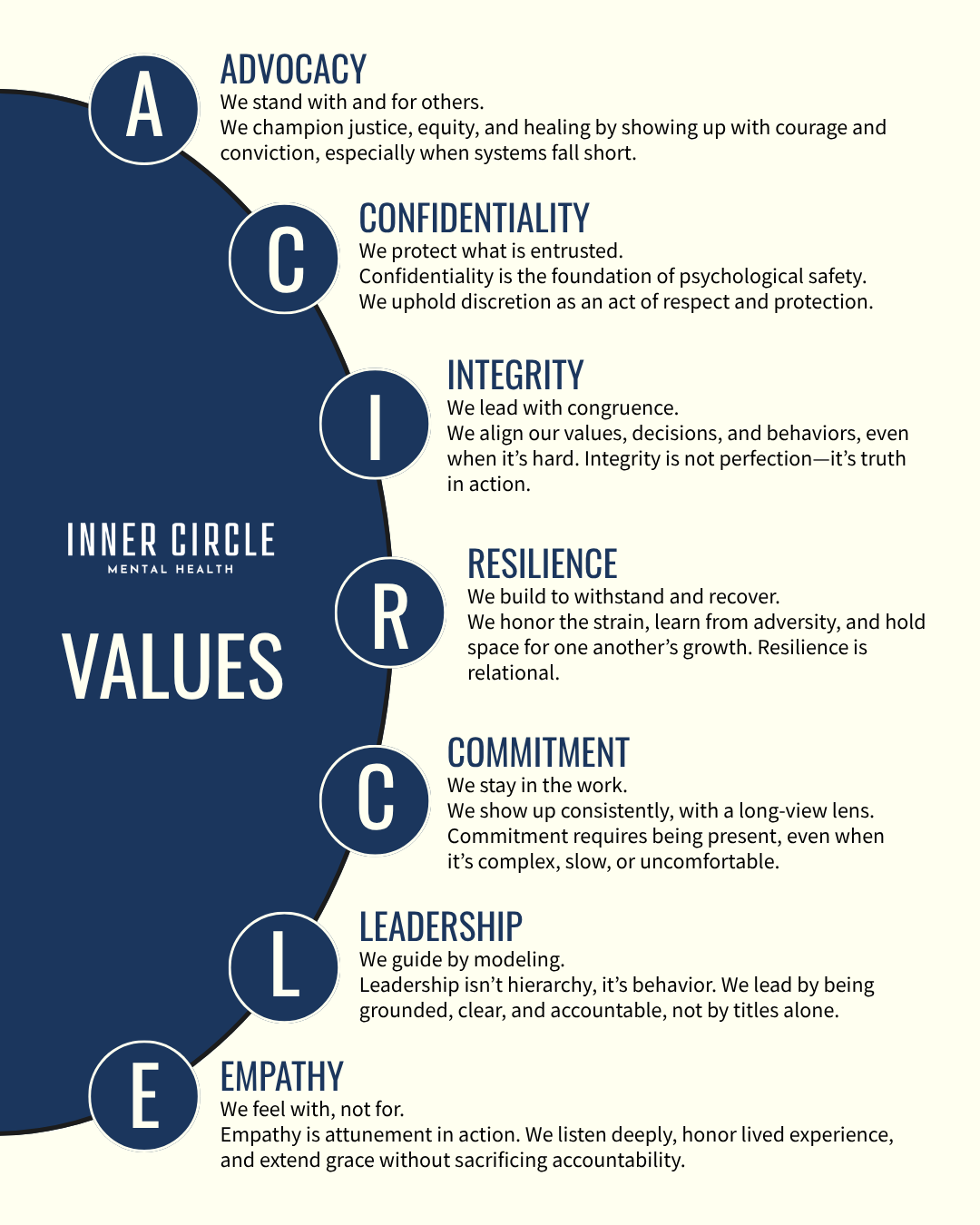
Developed by Autumn Cooper (LPC-S, PhD(c)), the ACIRCLE values are not aspirational language.
They are the standards that govern how we show up when things get complicated, uncomfortable, or politically inconvenient.
Inner Circle was built outside of systems by design. As a private mental health organization, we are not constrained by institutional priorities, reporting structures, or optics. That independence allows us to do what systems often cannot: advocate fiercely, protect confidentiality without compromise, and stay in the work even when it’s hard.
We do not back down when care requires courage.
We do not soften truth to preserve comfort.
We do not abandon people when the process becomes slow, complex, or unpopular.
Each value in the ACIRCLE framework reflects how we operate in real life — with clients, departments, leaders, and one another. Advocacy means we stand with, not above. Confidentiality is non-negotiable. Integrity guides decisions even when there’s a cost. Resilience is relational, not performative. Commitment means we stay when others disengage. Leadership is modeled, not titled. Empathy is attunement with accountability.
These values are not branding.
They are the reason people trust us when the stakes are high — and the reason systems sometimes feel challenged by our presence.